Oct 01, 2023
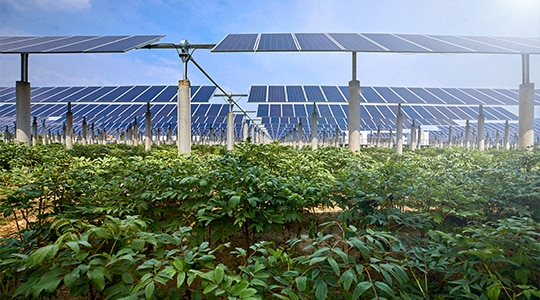
Solar sharing involves installing solar panels above farmland to allow simultaneous use for agriculture and power generation. This approach supports stable farm income, encourages successors, and utilizes idle farmland. However, crop selection must be appropriate, and temporary farmland conversion must be approved. Yanmar promotes solar sharing as part of its YANMAR GREEN CHALLENGE 2050 to help build a decarbonized society.
Solar sharing, also known as agrivoltaics, involves installing solar panels above farmland to share sunlight between crop production and power generation. In addition to revenue from crops, farmers can earn income by selling electricity to utilities or using it to support farm operations. Approved by Japan’s Ministry of Agriculture, Forestry and Fisheries in March 2013, solar sharing has been gradually adopted. Its success depends on maintaining productive farming while effectively integrating solar power systems.
In some countries and regions, solar sharing operators can benefit from Feed-in Tariff (FIT) programs, which guarantee fixed-price purchases of solar power. Low-voltage solar sharing systems also receive preferential tax treatment for self-consumption, enabling more predictable generation-revenue planning.
Solar sharing offers a potential solution to key challenges in Japanese agriculture, including a shortage of successors, increasing abandoned farmland, and declining income. The Yanmar Group has launched the YANMAR GREEN CHALLENGE 2050 to help build a decarbonized society. Yanmar Energy System is actively promoting renewable energy, including solar and biogas power generation, to support the transition to a more sustainable future. For questions or inquiries about energy solutions, please feel free to contact us.