Oct 01, 2025

In order to achieve carbon neutrality by 2050, companies are required to take concrete actions toward decarbonization businesses.
On the other hand, on the ground there are cases facing the challenge of “not understanding how to proceed with carbon neutrality.”
The Yanmar Group has formulated the roadmap “YANMAR GREEN CHALLENGE 2050” to achieve carbon neutrality.
In this article, we introduce “how to create a carbon-neutral roadmap,” based on the Yanmar Group’s insights.
The roadmap may become handy when working on developing your roadmap.
Carbon neutrality refers to the state in which the amount of carbon dioxide (CO2) emitted by human activities is equal to the amount of CO2 absorbed, resulting in a net zero balance.
In October 2020, the Japanese government declared its commitment to achieving carbon neutrality and a decarbonized society by 2050. Furthermore, in February 2025, it announced the "7th Strategic Energy Plan," which serves as an interim target toward the realization of carbon neutrality by 2050, aiming for a 73% reduction in greenhouse gas emissions by 2040 compared to 2013 levels.
Thus, the realization of carbon neutrality necessitates the formulation of plans from a medium- to long-term perspective. The carbon neutrality roadmap outlines a strategic plan for companies to work toward achieving net zero greenhouse gas emissions. It is not merely a slogan, but a pillar of medium- to long-term management strategy.
As efforts toward a decarbonized society accelerate globally, including in Japan, the formulation of a carbon neutrality roadmap is a challenge that is required not only for leading companies but for all industries.
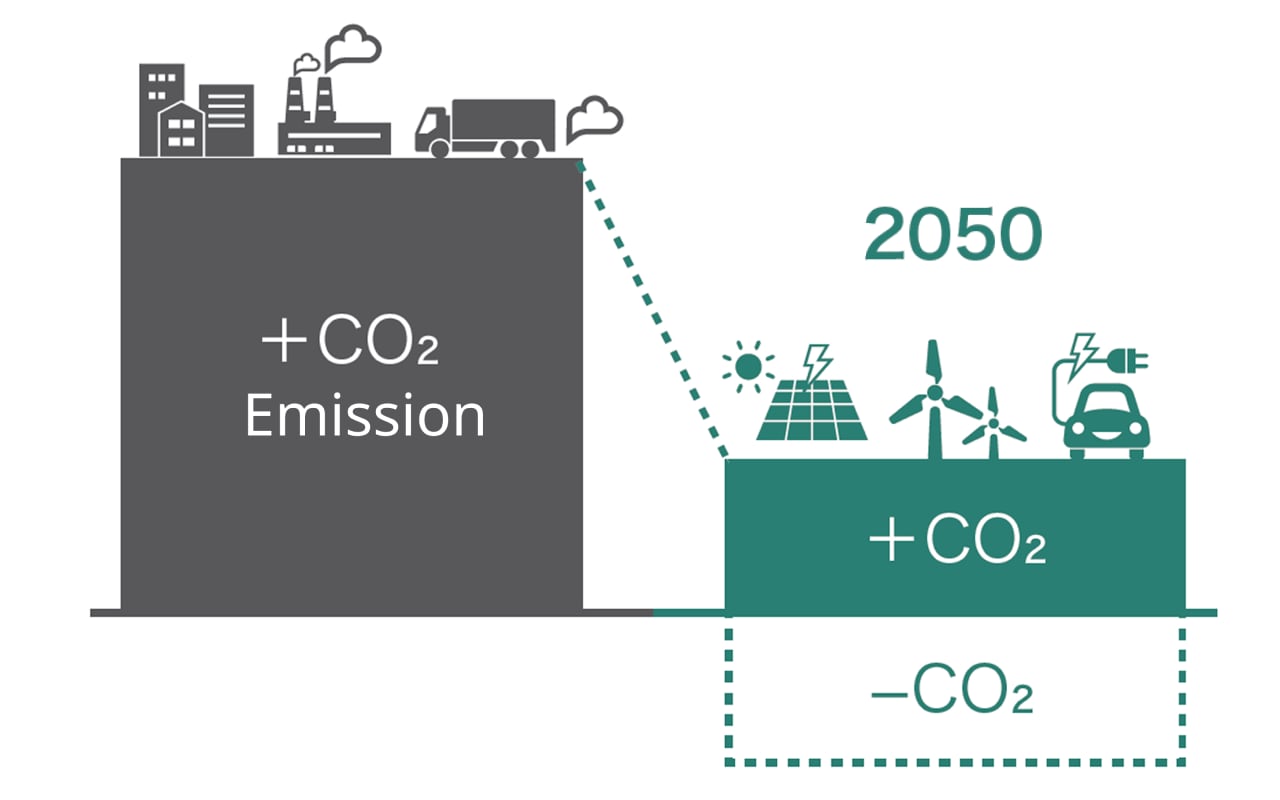
The development of a carbon-neutral roadmap has become indispensable for businesses. Here are some reasons.
First, to respond to social demands and ensure social trust. Various stakeholders, including investors, business partners, and consumers, are closely watching what path companies are charting and implementing toward 2050. Additionally, by presenting a concrete roadmap, companies can enhance their brand image, improve fundraising capabilities, and attract talent.
Second, to reduce costs and risks. Future business risks are increasing, including soaring energy prices, the introduction of carbon taxes and emissions regulations, and the expansion of supply chains that require environmental considerations. Utilizing energy conservation and renewable energy can reduce energy costs in the long term and lower the risk of losing business opportunities.
Third, new business and growth opportunities. By investing in energy-saving measures, introducing renewable energy, and developing decarbonization technologies and services, you can create new business opportunities. The formulation of a roadmap serves as a compass that indicates the direction for new businesses and innovation.
From the above, efforts toward carbon neutrality should be reconsidered not merely as CSR (Corporate Social Responsibility) activities but as a “management strategy map” for ensuring a company’s growth and sustainability.
The elements that should be included in a carbon-neutral roadmap are as follows: Organizational structure: Establish an organization to promote carbon-neutral initiatives. Understanding CO2 emissions: It is necessary to assess the current status of your company or organization according to Scope 1, Scope 2, and Scope 3.
| Category | Examples of emissions | |
|---|---|---|
| Scope 1 | Direct emissions | Direct CO2 emissions from on-site power generation, vehicle fuel use, industrial processes, etc. |
| Scope 2 | Indirect emissions from purchased energy | Indirect emissions associated with the consumption of purchased electricity and heat |
| Scope 3 | Indirect emissions other than Scope 2 (indirect emissions related to the company’s activities, including the supply chain) | All indirect emissions related to the company’s activities, such as the supply chain (raw material procurement and logistics), product use and disposal |
Setting targets: Companies should set concrete numerical targets for the goals they aim to achieve. It is best to set goals from short-term to mid-term to long-term perspectives. For example, set carbon neutrality by 2050 as the ultimate goal, and establish interim targets along the way such as a reduction of XX% by 2030 and XX% by 2040.
Reduction measures and implementation plan: Analyze the company’s characteristics (strengths and weaknesses) and present specific initiatives.
| Item | Specific example |
|---|---|
| Investment in energy-saving equipment | Introducing energy-saving equipment and improving energy operations |
| Introduction of renewable energy | Self-consumption through the adoption of solar power generation and biofuel power generation |
| Fuel switching | Switching to clean fuels such as hydrogen and biomass fuels |
| Resource circulation | Recycling waste and effective use of by-products |
| Collaborating with supply chain | Emissions reduction across the entire supply chain, including raw material suppliers and logistics operators |
Regular monitoring and reporting: Based on the short-, medium-, and long-term targets you have set, regularly check progress. Review and improve measures as necessary. We will disclose progress both internally and externally to ensure transparency.
At Yanmar, we have formulated our own carbon-neutral roadmap, “YANMAR GREEN CHALLENGE 2050.” We spoke with Munenori Miyamoto of the Yanmar Green Challenge Division, who led the formulation and promotion of the roadmap, about how the carbon-neutral roadmap was developed and what the key points are.
Profile: Ph.D. Munenori Miyamoto
Head of Yanmar Green Challenge Division, Sustainability Promotion Division, Yanmar Holdings Co., Ltd.,
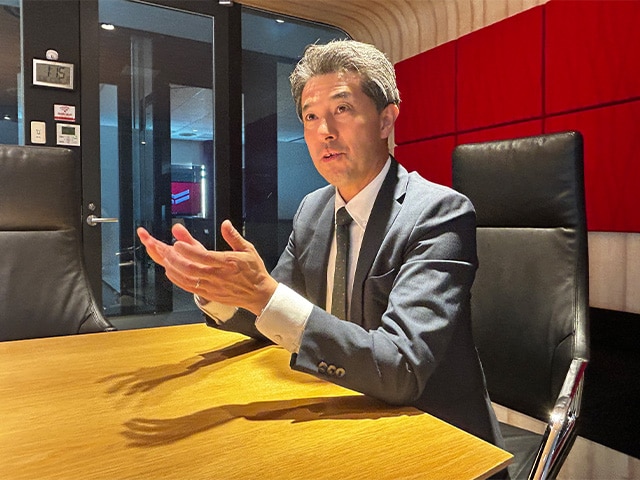
Joined Yanmar in 1997. Majored in mechanical engineering (robotics) in university and graduate school. Motivated by a desire to “create agricultural robots,” he joined Yanmar. In 2014, he developed the industry’s first combine equipped with combine information support functions (yield sensor and loss sensor), pioneering what is now known as smart agriculture. In 2017, he was assigned to the central research institute and led research and development on smart agriculture. From 2019, he was posted to Yanmar Europe Research Center in Italy as vice president, responsible for launching agricultural research projects. In Europe, advanced initiatives in sustainable agriculture—such as decarbonization and reducing environmental impact—are progressing, and he gained a great deal of local insight.
Currently in charge of the “YANMAR GREEN CHALLENGE 2050,” and promoting various projects aimed at realizing a sustainable society, including environmental initiatives and launching new businesses.
Miyamoto: This time, we announced the “YANMAR GREEN CHALLENGE 2050,” but it is by no means an initiative that we started “suddenly.” Yanmar has a history of conducting business with awareness of the global environment since its foundation.
The “Kyoto Protocol”, adopted in December 1997, was the world’s first international agreement to impose numerical targets for greenhouse gas reductions on developed countries. At Yanmar, we formulated the “2012 Environmental Vision” in 2005, setting 2012—the final year of the Kyoto Protocol—as the target year. 2012 marked the 100th anniversary of the founding of the Yanmar Group and was a milestone for clarifying the group’s overall environmental initiatives. We have continued to review and evolve our vision in response to major turning points in environmental issues.
Furthermore, in line with the 2015 Paris Agreement we formulated the “Group Environmental Vision 2030.” In 2016, we established our brand statement, “A SUSTAINABLE FUTURE.”
In 2020, prompted by the Japanese government’s “carbon neutral declaration,” we strengthened and accelerated our efforts to realize “A SUSTAINABLE FUTURE” and updated our “Group Environmental Vision 2030” to formulate the “YANMAR GREEN CHALLENGE 2050.” This sets out concrete actions toward achieving an environment-friendly, zero-impact society including carbon neutrality, and represents an important initiative aimed at a sustainable future.
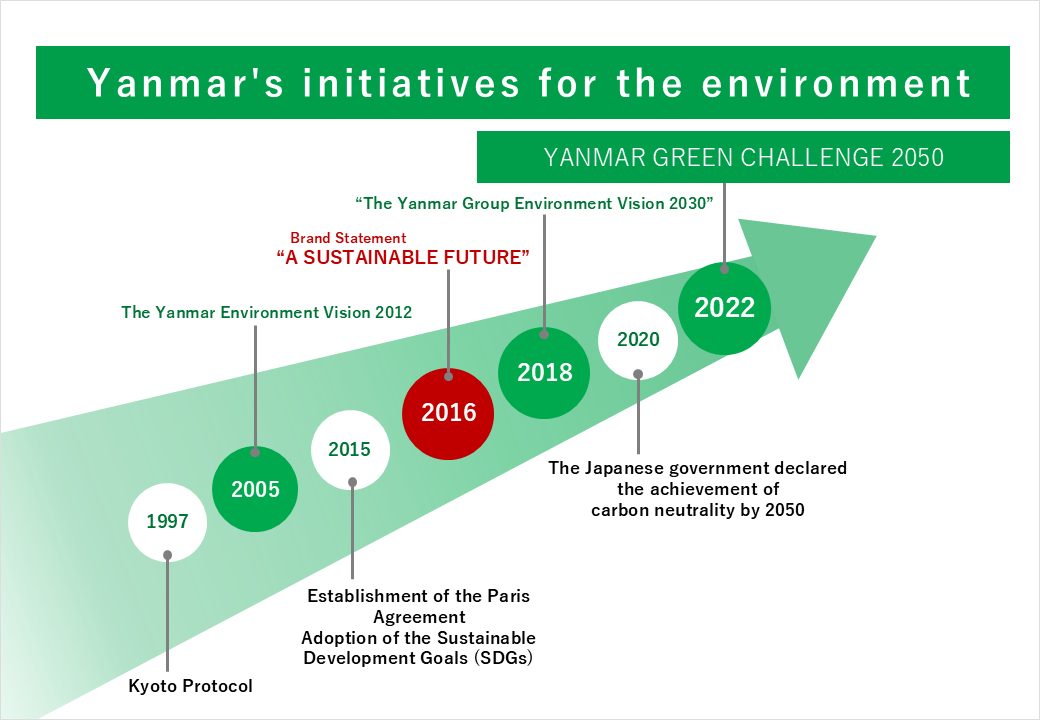
Miyamoto: The subtitle of the brand statement “A SUSTAINABLE FUTURE” is “New Value through Technology.” Indeed, technology is Yanmar’s strength.
Since our founding, we have focused our business on internal combustion engines. The engines are one of the machines that emit GHGs (greenhouse gases), but Yanmar is on the “manufacture” side, not the “user” side. We believe it is our mission, through Yanmar’s technology, to advance the greening of powertrains and contribute to reducing our customers’ GHG emissions.
Miyamoto: The project officially launched in 2021. In fiscal 2021, the “Global Environment Committee,” attended by the holdings’ directors, heads of functional departments, and presidents of group companies responsible for business operations, deliberated on and approved the initiatives of the “YANMAR GREEN CHALLENGE 2050.” Subsequently, to make it the highest priority of management, it was submitted to the “Group Strategy Meeting,” and after approval, full-scale group-wide activities began in fiscal 2022.
At the same time as formulating it, we placed emphasis on establishing a management/promotion framework. No matter how excellent the content is, it is meaningless if it cannot be put into practice. So, I conducted individual briefings with the heads of each group company, obtained their agreement, grouped BUs (Business Units) and RUs (Regional Units) in the most appropriate way, organized committees, appointed their leaders, and adjusted the current structure. Since Yanmar also has overseas bases, establishing an overseas structure was indispensable.
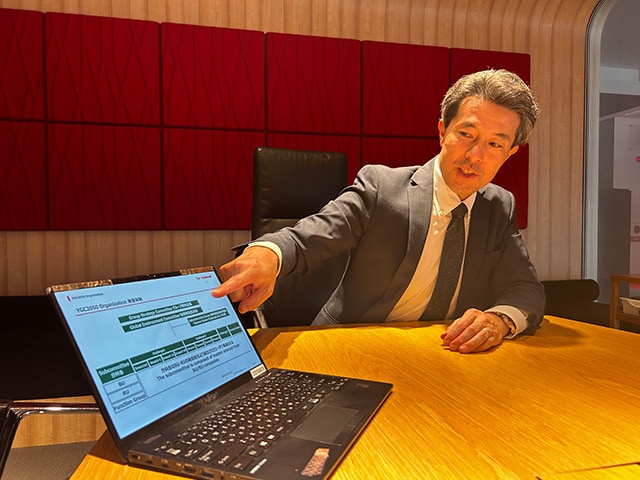
Miyamoto: In establishing the initial structure, the Innovation & Technology Division took the lead from the perspective that the Yanmar Group’s GHG reductions and lowering of environmental impact should be achieved by changing manufacturing through our own innovations and technologies.
The original team structure (Yanmar Green Challenge Promotion Office) was a mixed team composed of members from the CSR division—who had been engaged in environmental conservation activities—and members from the Innovation & Technology Division. After that, we expanded the team by adding employees interested in the “YANMAR GREEN CHALLENGE 2050” through an internal recruitment program.
Miyamoto: Yanmar has established the brand statement “A SUSTAINABLE FUTURE – New Value through Technology –.” The “YANMAR GREEN CHALLENGE 2050” is one of the foundations for achieving “A SUSTAINABLE FUTURE” and is set as a significant strategic challenge for the entire group.
In formulating the roadmap, we proceeded with the perspective of “What should the Yanmar Group currently undertake and achieve to realize 'A SUSTAINABLE FUTURE' and build a sustainable society?” We have established the following specific goals:
Miyamoto: The development of the roadmap is the first initiative for the group. In fact, the group has companies not only in Japan but also in Europe, Turkey, India, China, Asia, North America, and South America. Given the circumstances in each country, the national targets regarding decarbonization are not uniform. Setting a singular milestone for the Yanmar Group amidst these differences was quite challenging.
Additionally, one of the difficulties was getting employees to perceive this as a personal responsibility. To be honest, there is a perception that “environmental issues seem like a service obligation.” When faced with daily goals such as sales and business expansion, it can be hard to get motivated when told, “Let’s reduce CO2!” Therefore, I believe education and awareness reform are necessary.
Regarding capital investment, making decisions for an “invisible future” was also a significant challenge. Given the expectation that electricity costs will rise, even when explaining that “investing in renewable energy now will secure stable power,” there is hesitation, as people think, “But spending from my wallet now is...” During the roadmap formulation, it is crucial to visualize these aspects with quantifiable data.
Miyamoto: For companies that are about to formulate a roadmap, I believe it is essential to first consider “how to address social issues within their business domain.” Specifically, starting with a thorough understanding of the current situation, identifying challenges, and organizing the company’s strengths and weaknesses will be the foundation for this process.
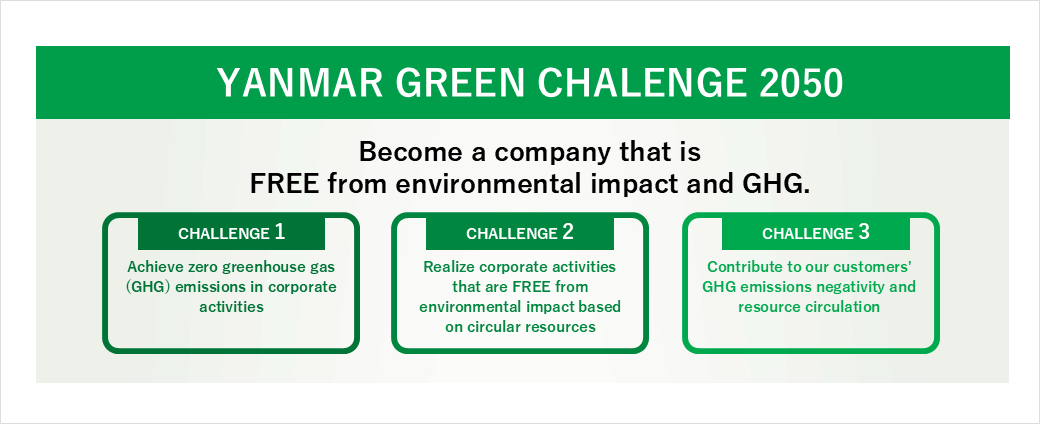
Miyamoto: The first challenge of the “YANMAR GREEN CHALLENGE 2050” is to become a GHG-free company. The second challenge is to achieve an environmentally burden free business model. In the third challenge, we aim to propose new GHG-negative business solutions to our customers, looking toward the future.
While we initially focus on realizing challenges one and two, taking on challenge three is also a personal dream for myself. For instance, in agriculture, we aim to reduce GHG methane emissions from rice paddies. This could involve using agricultural machinery for farming practices, as well as incorporating biochar to sequester carbon in the soil. I want to leverage Yanmar’s technology to solve our customers’ challenges.
Miyamoto: In the “YANMAR GREEN CHALLENGE 2050,” we have established three challenges to achieve our goal of becoming an environmentally friendly and GHG-free company based on circular resources: “Challenge 1,” “Challenge 2,” and “Challenge 3.”
The roadmap incorporates the Yanmar Group’s and suppliers’ corporate activities for “Challenge 1” and “Challenge 2,” while “Challenge 3” focuses on contributing to our customers’ GHG reduction efforts.
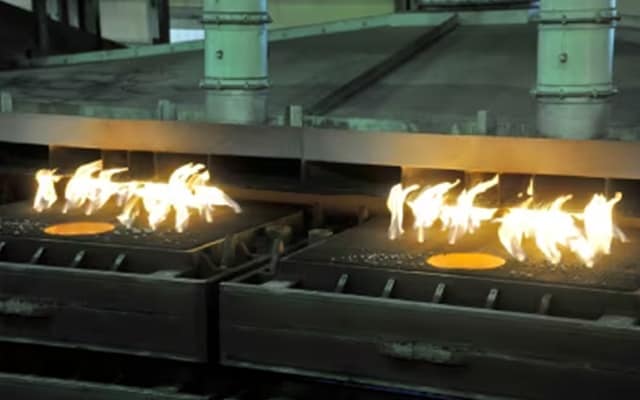
At Yanmar Casting Technology Koka Division, which casts various engine parts including small diesel engines, we formulated our own “Carbon Neutral Roadmap” with support from the Yanmar Green Challenge Division and Yanmar Energy Systems.
Engine manufacturing uses a process called casting, in which metal is melted at high temperatures and poured into molds to form shapes. Within the Yanmar Group, the Koka Division, which consumes large amounts of energy, faced the major challenge of reducing CO2 emissions.
In developing the roadmap, the Yanmar Green Challenge division connected the business units with Yanmar Energy Systems, and the concrete decarbonization support was provided by Yanmar Energy Systems.
“After implementing the improvements following the roadmap, we expect to reduce CO2 by about 1,000 tons per year. This reduction is equivalent to planting approximately 71,400 Japanese cedar trees. Yanmar Energy Systems is an energy specialist with extensive knowledge and technology in energy saving and generation, including cogeneration systems, its own decarbonization support services, and energy services. Additionally, from the perspectives of supporting social infrastructure—such as ensuring resilience with emergency generators—and providing distributed regional energy supply, I think they are a company you can consult with across the board,” says Miyamoto.
To achieve carbon neutrality by 2050, companies are required to understand their current energy situation, develop a “carbon neutrality roadmap” tailored to their business, and undertake decarbonization efforts with medium- to long-term planning. We at Yanmar offer a decarbonization support service to assist companies in formulating their carbon-neutral roadmaps.