Advanced Development Division
Development Division
YANMAR AGRIBUSINESS CO., LTD.
YANMAR Technical Review
Development of the Straight Driving Assist Tractor Series
Driving Control Improvements to Expand Lineup of Autonomous Agricultural Machinery
Abstract
In response to the deepening shortage of farm labor, Yanmar is expanding its SMARTPILOT® series of agricultural machinery with autonomous driving, introducing its cost-effective Straight Driving Assist solution for tractors of all sizes.
The system combines a GNSS antenna, a steering unit, and a user-friendly display, enabling easy operation. Customers can choose D-GNSS for routine tasks or RTK-GNSS for high-precision operations.
In particular, Yanmar has developed two key technologies to overcome the heightened sensitivity of small machines to disturbances and the demands of ultra-low-speed operation. Side-slip suppression control leverages yaw rate and vehicle dynamics to counter lateral slip, and a proprietary yaw estimation function based on a Kalman filter prevents heading drift at ultra-low speeds.
These advances ensure that Straight Driving Assist operation is stable and accurate across Yanmar’s full existing lineup of YT tractors.
1. Introduction
A worsening agricultural labor shortage is accompanied by demand for agricultural machinery that anyone can operate at the same level as an experienced farm worker. In response, many years of research and development by Yanmar culminated in the commercialization of robot tractors. With the goal of providing automatic operation for anything with a steering wheel, this technology developed for robot tractors is now being extended to a wide range of other equipment. Specifically, Yanmar is expanding its SMARTPILOT® series of agricultural machinery equipped with autonomous driving to make farm work more efficient and accurate as well as less labor-intensive.
This work has included the development of tractors with a Straight Driving Assist function specially designed for driving in a straight line. This article backgrounds the development of Straight Driving Assist and describes the technology, which is suitable for application on a wide range of tractors both small and large.
2. Market Requirements for Straight Driving Assist
As the robot tractor first released in 2018 was able to operate autonomously over approximately 90% of farmland under visual supervision, it allowed anyone to perform work at the level of an experienced worker. It also offered productivity and efficiency gains by allowing two-tractors/one-driver tandem operation in which the operator drives their own tractor alongside the robot tractor.
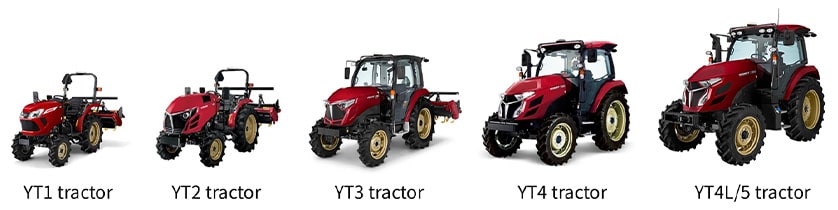
While the robot tractor earned a positive reputation wherever it was used, it also became clear that there was demand for further reducing the cost and practical barriers to adopting autonomous driving. In response, Yanmar focused on automating straight-line driving, the type of driving that makes up the largest proportion of vehicle operation. This led to the release of a full lineup of tractors both small and large that were equipped with Straight Driving Assist based on the concept of offering simple and low-cost machines that perform work at the level of an experienced worker (Figure 1).
While the core technology for automatic driving in a straight line has already been developed for the robot tractor, new issues emerged when extending its use to small and medium-sized machines. Compared to large tractors, these smaller machines are more affected by the condition of the farmland they are driving over, such as slippery or uneven ground, making it difficult for the existing technology to keep vehicles driving in a straight line with the accuracy Yanmar was seeking. Tasks such as azenuri (the coating of rice paddy embankments with dirt to help them retain water) for which small and medium-sized tractors are commonly used require that the vehicle be able to drive precisely in a straight line even at ultra-low-speed. To overcome this problem, Yanmar developed an automatic steering technique suitable for use on tractors of various different sizes. This new technology is being progressively rolled out to Yanmar’s robot tractors also.
3. Straight Driving Assist Overview and New Technologies
3.1. Overview of Straight Driving Assist
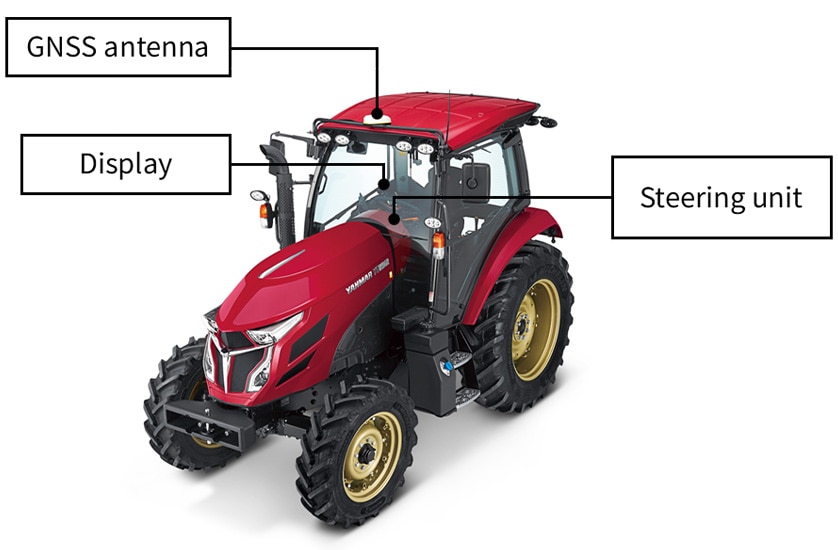
Yanmar Straight Driving Assist tractors are equipped with a GNSS antenna, display, and steering unit (Figure 2). The system keeps the tractor driving in a straight line by using the data from the GNSS antenna to determine how to steer the vehicle along the target route specified using the display interface, and by using the steering unit to control the steering angle.
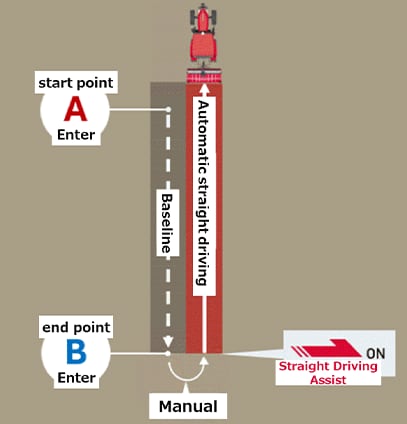
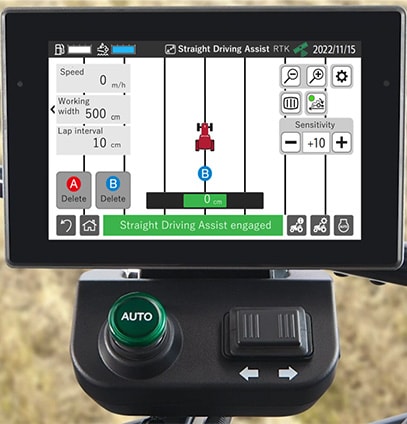
Automatic steering by Straight Driving Assist is simple to use, it is invoked by a three-step process of specifying the start and end points (points A and B) and then instructing the system to start driving (Figure 3). The Straight Driving Assist screen (Figure 4) is intuitive and easy to understand, with a simple screen design that makes automatic steering easy for anyone to use.
The system also offers a choice of two different GNSS antennas to facilitate low-cost adoption by a larger number of customers. The low-cost differential global navigation satellite system (D-GNSS) is suitable for rotary tilling which is less demanding of accuracy while the real-time kinematic global navigation satellite system (RTK-GNSS) is available for tasks such as azenuri or building rice-field ridges that require precise driving in a straight line. Having this choice based on the required accuracy improves the product’s cost-benefit ratio for the customer.
3.2. New Technologies Used in Straight Driving Assist
(1) Side-slip suppression control
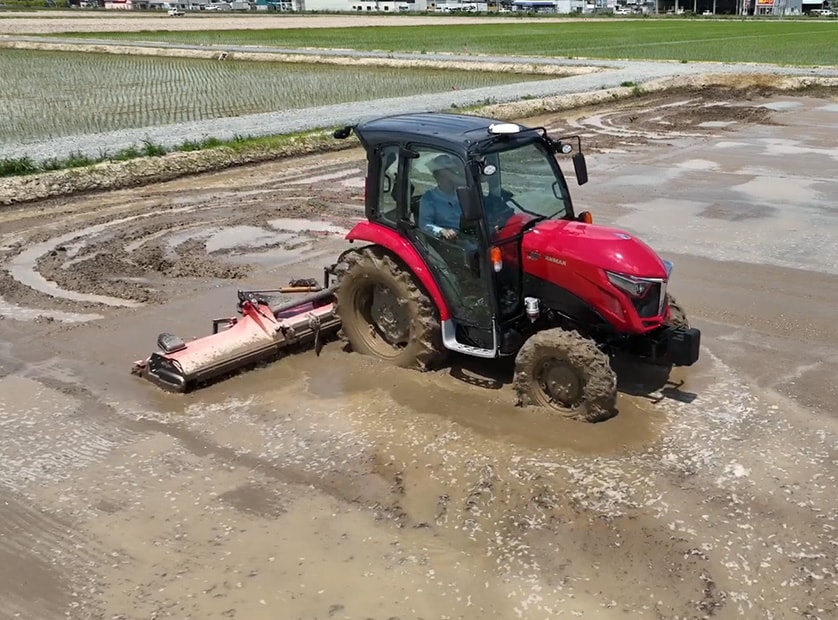
Tractors have a tendency to slip sideways when driving in flooded paddy fields (Figure 5) or on uneven ground. While the effect is small enough to ignore on large tractors that are inherently less affected by the conditions, this is not the case for small and medium-sized tractors where vulnerability to disturbances can severely degrade the accuracy of straight-line driving. Conventional control practice is to maintain a straight line by calculating the required steering angle from the divergence between the target route and the vehicle’s actual orientation and position. This divergence tends to be large in conditions that cause significant slipping. Because this effect is so severe in lightweight vehicles like small and medium-sized tractors, it is necessary to bring the vehicle back on course immediately. Unfortunately, the slow response of existing control techniques means that the tractor often slips further before it can correct the divergence caused by previous slipping, with the result that its movement becomes erratic and straight-line performance deteriorates.
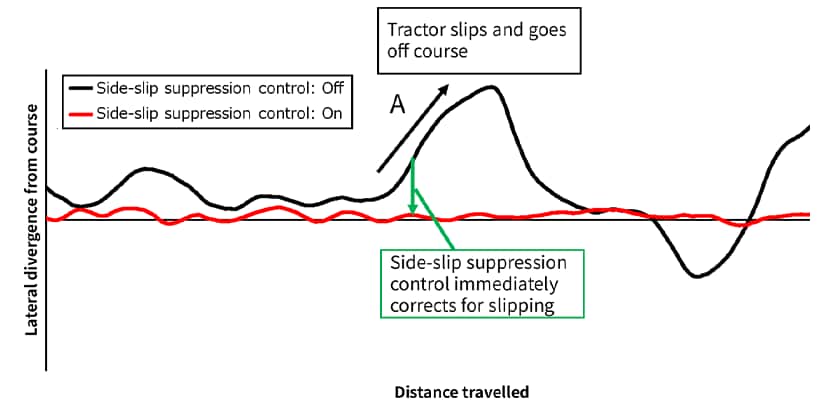
In response, Yanmar developed a side-slip suppression control technique that, in addition to divergence from the target route, also detects when side-slip occurs and compensates for it immediately (Figure 6). This technique determines the amount of side-slip by comparing the actual angular velocity of the tractor with the angular velocity for the no-slip case calculated from the steering angle and a vehicle model. An inverse model of the tractor is then used to calculate how much steering angle input is needed to counteract this amount of side slip. This becomes the control output of the system and provides immediate correction (patent pending).

Figure 7 shows a comparison of tractor performance in a flooded paddy field with and without side-slip suppression control. Region A in the figure shows an instance of poor straight-line performance with control turned off in which the tractor slipped and diverged significantly from its route. By contrast, when control is turned on under these conditions, the slip is corrected immediately and its effect on performance is considerably reduced.
In this way, use of this proprietary Yanmar technology maintains a high degree of straight-line accuracy even when driving on slippery ground.
(2) Technique for operating at low speed
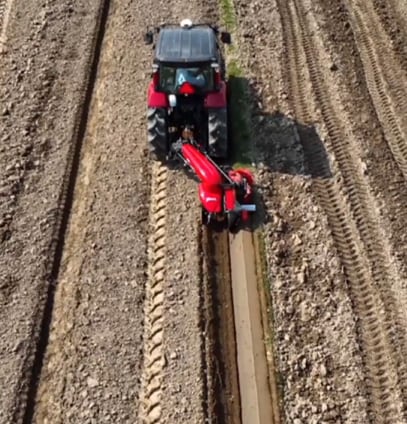
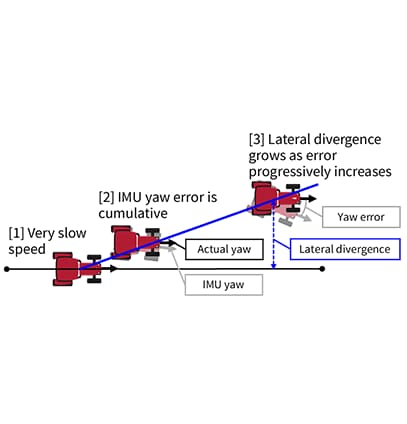
The vehicle yaw angle is detected by an inertial measurement unit (IMU) that is part of the GNSS antenna. When driving at ultra-low-speed of around 0.2 km/h, however, as occurs in tasks such as azenuri (Figure 8), this yaw angle is subject to minute errors. This poses a problem because the yaw error grows with time, sending the vehicle increasingly off course as it does so (Figure 9).
To overcome this problem, Yanmar developed a proprietary yaw estimation function based on a Kalman filter (Figure 10). A feature of the function is that it exploits the different characteristics of the yaw angles determined by the IMU and estimated by the Kalman filter respectively. While the IMU has a rapid response to changes in yaw angle, error tends to accumulate when moving at ultra-low-speed. By contrast, the error in the yaw angle estimated by the Kalman filter is low even at ultra-low-speed due to being based on vehicle information (inputs to the filter include positioning information and the speed and angular velocity of the tractor). Its response, however, is relatively slow due to its use of position feedback. Accordingly, Yanmar developed its own filter that combines the best characteristics of both methods, enabling the precise calculation of yaw angle with less error at ultra-low-speed (patent pending).

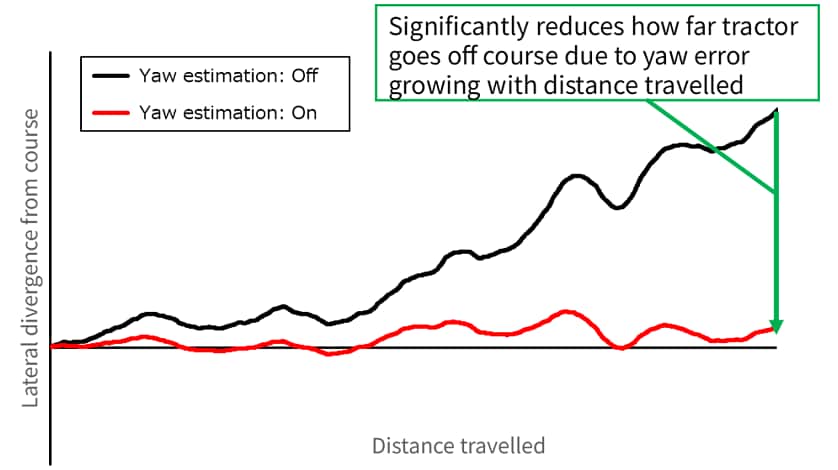
Figure 11 shows a comparison of yaw estimation performance when driving at ultra-low-speed with and without the new function. When turned off, the yaw angle error progressively increases and the tractor diverges from its intended route. When turned on, by contrast, the yaw angle calculation maintains its accuracy and divergence from the intended route is kept to a minimum.
In this way, the technique expands the range of uses to which the tractor can be put by keeping it driving in a precise straight line even when performing tasks such as azenuri that involve ultra-low-speed.
4. Conclusions
A major issue that arises when extending the use of automatic straight-line steering to small and medium-sized machines is optimizing the differences in steering system response to enable operation over a wide range of speeds and to deal with the different ways in which vehicles of different sizes respond to driving disturbances. In addition to equipping its tractors with interfaces designed for ease-of-operation, Yanmar has also developed techniques for suppressing side-slip and for estimating yaw at ultra-low-speed to provide reliable automatic straight-line driving that is easy to use regardless of vehicle size. Straight Driving Assist is currently available on all YT Series tractors and is being put to use on farms throughout Japan.
In the future, Yanmar intends to further develop its SMARTPILOT® machines to satisfy the needs of an even wider range of agricultural applications.
-IMPORTANT-
The original technical report is written in Japanese.
This document was translated by Innovation & Technology Division, Technology Strategy Division.
Authors


Advanced Development Division
Development Division
YANMAR AGRIBUSINESS CO., LTD.